
Notice also the tiny (R) sign. By linking the image here, I'm probably violating a copyright... so they might charge me a lot more than $1,99...
(Voir aussi: lien interne)
P.S. Check out also the comments to Telegraph's article... heehee...
Die Philosophie ist eigentlich Heimweh, ein Trieb überall zu Hause zu Sein.

As apothecaries we make new mixtures everyday, pour out of one vessel into another; and as those old Romans robbed all the cities of the world, to set out their bad-sited Rome, we skim off the cream of other men's wits, pick the choice flowers of their tilled gardens to set out our own sterile plots. Castrant alios ut libros suos per se graciles alieno adipe suffarciant (so Jovius inveighs.) They lard their lean books with the fat of others' works. Ineruditi fures, &c. A fault that every writer finds, as I do now, and yet faulty themselves, Trium literarum homines, all thieves; they pilfer out of old writers to stuff up their new comments, scrape Ennius' dunghills, and out of Democritus' pit, as I have done. By which means it comes to pass, "that not only libraries and shops are full of our putrid papers, but every close-stool and jakes," Scribunt carmina quae legunt cacantes; they serve to put under pies, to lap spice in, and keep roast meat from burning. "With us in France," saith Scaliger, "every man hath liberty to write, but few ability." "Heretofore learning was graced by judicious scholars, but now noble sciences are vilified by base and illiterate scribblers," that either write for vainglory, need, to get money, or as Parasites to flatter and collogue with some great men, they put cut burras, quisquiliasque ineptiasque. Amongst so many thousand authors you shall scarce find one, by reading of whom you shall be any whit better, but rather much worse, quibus inficitur potius, quam perficitur, by which he is rather infected than any way perfected. [...] So that oftentimes it falls out (which Callimachus taxed of old) a great book is a great mischief. Cardan finds fault with Frenchmen and Germans, for their scribbling to no purpose, non inquit ab edendo deterreo, modo novum aliquid inveniant, he doth not bar them to write, so that it be some new invention of their own; but we weave the same web still, twist the same rope again and again; or if it be a new invention, 'tis but some bauble or toy which idle fellows write, for as idle fellows to read, and who so cannot invent?

Point d’ironie n° 37 by Ed Ruscha at agnès b., rue du Jour, Paris. Sculpture by Jen-chri.
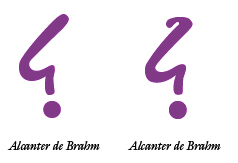
Plusieurs raisons ont été avancées pour expliquer le manque de succès du point d'ironie en tant que signe de ponctuation :
* Les signes comme le point d'interrogation ou le point d'exclamation servent généralement à retranscrire la façon dont est ponctuée la phrase à l'oral. Or, une phrase ironique n'est pas forcément ponctuée d'une certaine façon. Parfois, seul le contexte permet de la reconnaître comme telle. D'ailleurs, les personnes qui se veulent ironiques jouent souvent sur l'ambiguïté. [C'est moi qui souligne, P.R.]
Wenn denn nun gefragt wird : Leben wir jetzt in einem aufgeklärten Zeitalter ? so ist die Antwort : Nein, aber wohl in einem Zeitalter der Aufklärung. [If it is now asked, “Do we presently live in an enlightened age?” the answer is, “No, but we do live in an age of enlightenment.”]Enlightenment, not "being enlightened" but "being in the process of enlightening [Aufklärung]" or "becoming enlightened," is reason's constant readiness for critical self-examination – a constant crisis and not a status quo.
Online texts:
German original, Immanuel Kant, "Beantwortung der Frage: Was ist Aufklärung?" (1783) – www.prometheusonline.de.
English translation, by H.B. Hisbet (?), "An Answer to the Question: What is Enlightenment?" (1784)

You are perhaps aware that the oldest manuscripts of the Gospel of Mark – the oldest canonical gospel – ended after 16:8 where the women discover Jesus' tomb to be empty and leave it in distress. "And they told ... no one anything; for they were afraid" (who is narrating this?)Thank you J. B., I hope you don't mind me quoting you.

XI.I. Cur confitemur deo scienti.See also Book X, Ch. 2:
Numquid, domine, cum tua sit aeternitas, ignoras, quae tibi dico, aut ad tempus vides quod fit in tempore? Cur ergo tibi tot rerum narrationes digero? Non utique ut per me noveris ea, sed affectum meum excito in te et eorum, qui haec legunt, ut dicamus omnes: magnus dominus et laudabilis valde. Iam dixi et dicam: amore amoris tui facio istuc. Nam et oramus, et tamen veritas ait: Novit pater vester quid vobis opus sit, priusquam petatis ab eo. Affectum ergo nostrum patefacimus in te confitendo tibi miserias nostras et misericordias tuas super nos, ut liberes nos omnino, quoniam coepisti, ut desinamus esse miseri in nobis et beatificemur in te, quoniam vocasti nos, ut simus pauperes spiritu et mites et lugentes et esurientes ac sitientes iustitiam et misericordes et mundicordes et pacifici. Ecce narravi tibi multa, quae potui et quae volui, quoniam tu prior voluisti, ut confiterer tibi, domino deo meo, quoniam bonus es, quoniam in saeculum misericordia tua.
Trans. Edward P. Pusey:
Lord, since eternity is Thine, art Thou ignorant of what I say to Thee? or dost Thou see in time, what passeth in time? Why then do I lay in order before Thee so many relations? Not, of a truth, that Thou mightest learn them through me, but to stir up mine own and my readers’ devotions towards Thee, that we may all say, Great is the Lord, and greatly to be praised. I have said already; and again will say, for love of Thy love do I this. For we pray also, and yet Truth hath laid, Your Father knoweth what you have need of, before you ask. It is then our affections which we lay open unto Thee, confessing our own miseries, and Thy mercies upon us, that Thou mayest free us wholly, since Thou hast begun, that we may cease to be wretched in ourselves, and be blessed in Thee; seeing Thou hast called us, to become poor in spirit, and meek, and mourners, and hungering and athirst after righteousness, and merciful, and pure in heart, and peace-makers. See, I have told Thee many things, as I could and as I would, because Thou first wouldest that I should confess unto Thee, my Lord God. For Thou art good, for Thy mercy endureth for ever.
Neque enim dico recti aliquid hominibus, quod non a me tu prius audieris, aut etiam tu aliquid tale audis a me, quod non mihi tu prius dixeris.
Trans. Edward P. Pusey:
For neither do I utter any thing right unto men, which Thou hast not before heard from me; nor dost Thou hear any such thing from me, which Thou hast not first said unto me.
Every multiple choice questionnaire should quote a song title by Frank Zappa as the last option of each question: "None of the Above."
Otherwise the questionnaire will not pay heed to singularity, reluctance, and the possibility of its own failure.
Through such an addition, most multiple choice questionnaires would not become any worse than they already are, even if it would make them useless in case of the respondent's reluctance to submit to the ready-made anticipations.
So, do you think MULTIPLE CHOICE POLLS SHOULD INCLUDE "NONE OF THE ABOVE" AS AN OPTION?
Using only song names from ONE ARTIST, cleverly answer these questions. Pass it on to 10 people or more (if you have time and want to do this) and include me. Try not to repeat a song title. Enjoy!
Pick Your Artist:
Frank Zappa
Are you male or female:
Man With the Woman Head
Describe yourself:
Jolly Good Fellow
How do you feel about yourself:
Harry, You’re a Beast
Describe where you currently live:
Motorhead's Midnight Ranch
If you could go anywhere you wanted to go:
The Eric Dolphy Memorial Barbecue
Your favorite form of transportation:
Space Boogers
Your best friend is:
Lonesome Electric Turkey
Your favorite color is:
White Ugliness
Favorite time of day:
What Will This Morning Bring Me This Evening?
If your life were a TV show, what would it be called:
You’re Probably Wondering Why I’m Here
What is life to you:
Aerobics in Bondage
What is the best advice you have to give:
Eat That Question
If you could change your name, what would it be:
Cletus Awreetus-Awrightus
Thought for the Day:
Jesus Thinks You’re a Jerk
How I would like to die:
G-Spot Tornado
My soul's present condition:
Prelude to the Afternoon of a Sexually Aroused Gas Mask
My motto:
None of the Above
A footnote in Jean-Jacques Rousseau's Essai sur l'origine des langues, towards the end of chapter V:
Punctuation, which does not have this defect, would be the best of such means if it were more complete. Why, for example, do we not have a vocative mark? The question mark, which we have, would be much less necessary, since a question is recognizable from its structure alone, at least in our language. Venez-vous and vous venez are not the same. But how is one to distinguish, in writing, between a man one mentions and a man one addresses. There really is an equivocation which would be eliminated by a vocative mark. The same equivocation is found in irony, when it is not made manifest by accent. (Jean-Jacques Rousseau, Essay on the Origin of Languages, trans. John H. Moran)
Le meilleur de ces moyens [qu’on prend, dans la langue écrit, pour suppléer à une langue accentuée], et qui n’aurait pas ce défaut, serait la ponctuation, si on l’eût laissée moins imparfaite. Pourquoi par exemple n’avons-nous pas ce point vocatif ? Le point interrogeant que nous avons était beaucoup moins nécessaire, car par la seule construction, on voit si l’on interroge ou si l’on n’interroge pas, au moins dans notre langue. « Venez-vous » et « vous venez » ne sont pas la même chose. Mais comment distinguer par écrit un homme qu’on nomme d’un homme qu’on appelle ? C’est là au moins une équivoque qu’eût levée le point vocatif. La même équivoque se trouve dans l’ironie quand l’accent ne se fait pas sentir.
Rousseau, whose use of irony is very delicate – infinitely more delicate than Voltaire's, as you must notice if you read their famous correspondence on Rousseau's apparently naïve idea of the "return to nature" – must be aware of the fact that irony, the only irony worthy of its name, is the one that is not immediately recognizable as such, i.e. qui ne se fait pas sentir. Therefore the only plausible way to read the footnote, and especially its final sentence, is to suspect irony in it (only to "suspect", because there is no way to confirm the presence of irony, inasmuch as it is true irony and not just mockery).
___
Cf. one variant of Celan's quote of Malebranche through Benjamin's essay on Kafka:My Heart Leaps Up When I Behold
by William Wordsworth
My heart leaps up when I behold
A rainbow in the sky:
So was it when my life began,
So is it now I am a man,
So be it when I shall grow old
Or let me die!
The Child is father of the Man:
And I could wish my days to be
Bound each to each by natural piety.
Aufmerksamkeit ist das natürliche Frömmigkeit der Seele.Here, Frömmigkeit instead of Gebet, piety instead of prayer: "Attention is the natural piety of the soul."*
No matter how much you abhor the acts of a mass of young people 30 years ago, their resilience and strength was admirable. They withstood years of persecution and brutal confrontations. We must both learn from them, and outsmart them because they already know all the rules.The ambivalence of the new "mass of young people", another generation, towards the revolutionary legacy ("abhor [...] admirable [...] learn from them, and outsmart them"), should wipe out the outsider's possible cynicism concerning the history, present and future of the Iranian revolution – as a revolution of revolutions, hopefully a movement towards democracy.
"Die Revolution ist wie Saturn, sie frißt ihre eignen Kinder." - Dantons Tod, 1. Akt, 5. Szene / Danton. Der diesem Zitat zugrunde liegende Ausspruch stammt von Pierre Vergniaud"The revolution is like Saturn, it devours its own children." But reading this quote, we must remember what actually happened to Saturn – or Kronos (Cronus), a name with the famous assonance with Chronos – and his children. They did not stay too long in his stomach. What revolves tends to return (see my post right below – the previous or the next one, depending on whether you look at it from a weblog writer's or a reader's perspective).
... and he vomited up first the stone which he had swallowed last. (Hesiod, Theogony 453, trans. Evelyn-White)Just imagine the pyrosis. The heartburn when you have a heart of stone.
While the outcome is unpredictable, what is certain is that the 70% of Iranian citizens under the age of 30 are children of the revolution; the experience is in their blood. I recall a quote from a protester outside London’s Iranian Embassy:‘As children of the revolution we have been conditioned to be revolutionaries. We grew up with the glorification of revolutionary songs, slogans, political graffiti, and stories of fearless characters standing up to the Shah’s army to topple the regime. While these were fed to us as propaganda of the Islamic regime, what they don’t realize is that they’ve trained us to revolt for what we believe in and now we’re putting all those years of revolutionary fervour into practice. The fearlessness Iranians now show towards the police, the slogans and perseverance in pursuing their cause, are all building towards something — we can’t go back from here, only forward.’
Copyright © 2009 Tehran Bureau
A "video comment" of sorts:
When I saw
Mushroom Head
I was born
And I was dead
They give birth astride of a grave, the light gleams an instant, then it's night once more. [Elles accouchent à cheval sur une tombe, le jour brille un instant, puis c'est la nuit à nouveau.]Is "dead" just a metaphor, then? Well — it most often is, as Blanchot might say — being mortal means being unable to die, because the ability to die and to be mortal "ends" with what we call "death" and what Heidegger calls "the possibility of impossibility", the ever-imminent possibility that all possibilities become impossible.
Räntäseula seudun päällä,
saappaan alla lotinaa,
lantajuova järven jäällä —
kesä tulee, ihanaa!
Upon the field — a sieve of sleet —
Slush is splashing underboot.
Upon the lake — a dungy strake —
'Twill be summer — wonderful!
Tous les écrivains pensent être réalistes. (Alain Robbe-Grillet.)It's not a question of realism being faithful to objectivity while experience is always subjective. This is a sophomoric misunderstanding.
Les fragments s'écrivent comme séparations inaccomplies; [...]This fragmentation or re-fragmentation of fragments is not meant as cheap witticism, just as indications of places to be re-read with care.
[...] les faisant persister de par leur inachèvement, toujours prêts alors à se laisser travailler par la raison infatigable, au lieu de rester la parole déchue, mise à part, le secret sans secret que nulle élaboration ne saurait remplir.
[...] ces paroles semblent-elles avoir besoin d'êtres reprises, répétées, pour échapper au sens qui les anime et afin d'êtres détournées d'elles-mêmes, du discours qui les utilise?
If words can be flowers (and they can) that can be fruits that can be deeds, is it not because flowers are words, flower is a word, flowers is a word?palabras que son flores que son frutos que son actos.
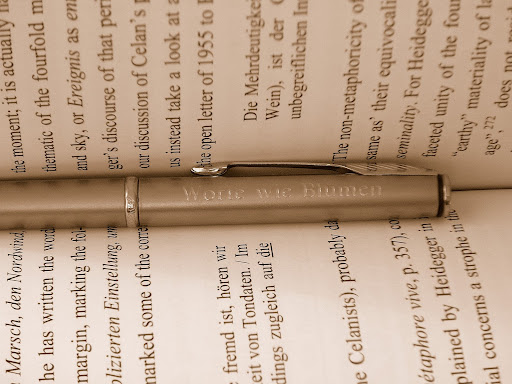
Métaphore - mais réelle. Vécue.*Jean Daive's Récit testifies to his friendship with Paul Celan.
Wir blieben in der Metaphysik hängen, wollten wir dieses Nennen Hölderlins in der Wendung »Worte wie Blumen« für eine Metapher halten.Outrageous, like poetry.
Woke up at three. Could not sleep, read some Hegel.
My reluctance to accept the thought that a poet could “give a voice to that which has none”, or in other words, to act as a stand-in of sorts in prayer (see my “Schreiben als Form des Gebets”) – or let’s say, even, my very disgust at the thought.
