Saturday, 25 July 2009

Writing As Exposure

"Schreiben als Form des Gebets" – there is always someone to read you better than you do. Why else would you write, anyway?

An oblique reference to St. Augustine.

* * *
An oblique reference, mutatis mutandis, to Augustine's question "Why we confess what God already knows," cur confitemur deo scienti.

Cur confitemur deo scienti, the phrase cited by Derrida in his Circonfession, is the title added to The Confessions, Book XI, Chapter I:
XI.I. Cur confitemur deo scienti.

Numquid, domine, cum tua sit aeternitas, ignoras, quae tibi dico, aut ad tempus vides quod fit in tempore? Cur ergo tibi tot rerum narrationes digero? Non utique ut per me noveris ea, sed affectum meum excito in te et eorum, qui haec legunt, ut dicamus omnes: magnus dominus et laudabilis valde. Iam dixi et dicam: amore amoris tui facio istuc. Nam et oramus, et tamen veritas ait: Novit pater vester quid vobis opus sit, priusquam petatis ab eo. Affectum ergo nostrum patefacimus in te confitendo tibi miserias nostras et misericordias tuas super nos, ut liberes nos omnino, quoniam coepisti, ut desinamus esse miseri in nobis et beatificemur in te, quoniam vocasti nos, ut simus pauperes spiritu et mites et lugentes et esurientes ac sitientes iustitiam et misericordes et mundicordes et pacifici. Ecce narravi tibi multa, quae potui et quae volui, quoniam tu prior voluisti, ut confiterer tibi, domino deo meo, quoniam bonus es, quoniam in saeculum misericordia tua.

Trans. Edward P. Pusey:

Lord, since eternity is Thine, art Thou ignorant of what I say to Thee? or dost Thou see in time, what passeth in time? Why then do I lay in order before Thee so many relations? Not, of a truth, that Thou mightest learn them through me, but to stir up mine own and my readers’ devotions towards Thee, that we may all say, Great is the Lord, and greatly to be praised. I have said already; and again will say, for love of Thy love do I this. For we pray also, and yet Truth hath laid, Your Father knoweth what you have need of, before you ask. It is then our affections which we lay open unto Thee, confessing our own miseries, and Thy mercies upon us, that Thou mayest free us wholly, since Thou hast begun, that we may cease to be wretched in ourselves, and be blessed in Thee; seeing Thou hast called us, to become poor in spirit, and meek, and mourners, and hungering and athirst after righteousness, and merciful, and pure in heart, and peace-makers. See, I have told Thee many things, as I could and as I would, because Thou first wouldest that I should confess unto Thee, my Lord God. For Thou art good, for Thy mercy endureth for ever.
See also Book X, Ch. 2:
Neque enim dico recti aliquid hominibus, quod non a me tu prius audieris, aut etiam tu aliquid tale audis a me, quod non mihi tu prius dixeris.

Trans. Edward P. Pusey:

For neither do I utter any thing right unto men, which Thou hast not before heard from me; nor dost Thou hear any such thing from me, which Thou hast not first said unto me.

Wednesday, 22 July 2009

"Multiple Choice" is an Insult Against Multiplicity

Every multiple choice questionnaire should quote a song title by Frank Zappa as the last option of each question: "None of the Above."

Otherwise the questionnaire will not pay heed to singularity, reluctance, and the possibility of its own failure.

Through such an addition, most multiple choice questionnaires would not become any worse than they already are, even if it would make them useless in case of the respondent's reluctance to submit to the ready-made anticipations.

So, do you think MULTIPLE CHOICE POLLS SHOULD INCLUDE "NONE OF THE ABOVE" AS AN OPTION?

  • Yes
  • No
  • None of the above

"My Life According to Frank Zappa"

Quoting my own Facebook self and "The Song Title Game" a.k.a. "My Life According to ...":

Using only song names from ONE ARTIST, cleverly answer these questions. Pass it on to 10 people or more (if you have time and want to do this) and include me. Try not to repeat a song title. Enjoy!

Pick Your Artist:
Frank Zappa
Are you male or female:
Man With the Woman Head
Describe yourself:
Jolly Good Fellow
How do you feel about yourself:
Harry, You’re a Beast
Describe where you currently live:
Motorhead's Midnight Ranch
If you could go anywhere you wanted to go:
The Eric Dolphy Memorial Barbecue
Your favorite form of transportation:
Space Boogers
Your best friend is:
Lonesome Electric Turkey
Your favorite color is:
White Ugliness
Favorite time of day:
What Will This Morning Bring Me This Evening?
If your life were a TV show, what would it be called:
You’re Probably Wondering Why I’m Here
What is life to you:
Aerobics in Bondage
What is the best advice you have to give:
Eat That Question
If you could change your name, what would it be:
Cletus Awreetus-Awrightus
Thought for the Day:
Jesus Thinks You’re a Jerk
How I would like to die:
G-Spot Tornado
My soul's present condition:
Prelude to the Afternoon of a Sexually Aroused Gas Mask
My motto:
None of the Above

One of My Theses on Irony

Anyone who thinks he or she is using irony may be in danger of being used by it. You don't impose irony, you expose yourself to it. Especially when you make statements concerning irony.

Tuesday, 21 July 2009

A Couple of My Favourite Text Samples, No. 1

A footnote in Jean-Jacques Rousseau's Essai sur l'origine des langues, towards the end of chapter V:

Punctuation, which does not have this defect, would be the best of such means if it were more complete. Why, for example, do we not have a vocative mark? The question mark, which we have, would be much less necessary, since a question is recognizable from its structure alone, at least in our language. Venez-vous and vous venez are not the same. But how is one to distinguish, in writing, between a man one mentions and a man one addresses. There really is an equivocation which would be eliminated by a vocative mark. The same equivocation is found in irony, when it is not made manifest by accent. (Jean-Jacques Rousseau, Essay on the Origin of Languages, trans. John H. Moran)
Le meilleur de ces moyens [qu’on prend, dans la langue écrit, pour suppléer à une langue accentuée], et qui n’aurait pas ce défaut, serait la ponctuation, si on l’eût laissée moins imparfaite. Pourquoi par exemple n’avons-nous pas ce point vocatif ? Le point interrogeant que nous avons était beaucoup moins nécessaire, car par la seule construction, on voit si l’on interroge ou si l’on n’interroge pas, au moins dans notre langue. « Venez-vous » et « vous venez » ne sont pas la même chose. Mais comment distinguer par écrit un homme qu’on nomme d’un homme qu’on appelle ? C’est là au moins une équivoque qu’eût levée le point vocatif. La même équivoque se trouve dans l’ironie quand l’accent ne se fait pas sentir.

Rousseau, whose use of irony is very delicate – infinitely more delicate than Voltaire's, as you must notice if you read their famous correspondence on Rousseau's apparently naïve idea of the "return to nature" – must be aware of the fact that irony, the only irony worthy of its name, is the one that is not immediately recognizable as such, i.e. qui ne se fait pas sentir. Therefore the only plausible way to read the footnote, and especially its final sentence, is to suspect irony in it (only to "suspect", because there is no way to confirm the presence of irony, inasmuch as it is true irony and not just mockery).

___

Internal link / Cross reference

Sunday, 19 July 2009

Caricature as Portraying Singularity

In order that a snapshot can have the quality of portrait, it must have something of the nature of caricature. Caricature is precisely the anti-snapshot, capturing something that is not simply momentary or even ephemeral, but characteristic: something that stays the same in different observations of a person's movements and gestures and facial expressions.

Yet, the singularity – the one that we strangely feel that we can observe – can be such that it can only be captured in a fleeting moment, drawn in a quick sketch or captured in a snapshot.

The object of our observation, the model herself, might not recognize the enduring nature of that observation, however. It might be alien to her own self-image or rather self-experience, even when everybody else, nous autres hommes, would confirm its vraisemblance.

– – –

Exposure time might be the question.

A case in point, or perhaps an antitype (an exception to prove the rule, as outlined above), the famous daguerreotype of Edgar Allan Poe, by W.S. Hartshorn (1848):


Some pictures make caricatures futile.

Tode ti – a quick note

Taking a shower, I thought I should write this down...

Singularity is, in temporal terms, not always the same as uniqueness. The singular (tode ti, in Aristotelian terms, "the this" or rather "some this") is the undefinable, beyond species or particular forms (eide) and their differentiae specificae (diaphorai). It is that which resists the temporal changes as well as universality. It is their support (subject, substratum, hypokeimenon), the guarantee of presence as beingness or "thingness" (ousia, translatable as essentia), but at the same time, beyond the presence of particulars and universals.

Thus, the Aristotelian notion of presence both supports the "metaphysics of presence" and points beyond it, to the undefinable singularity – which could be also ephemeral and not necessarily eternal.

Yet, this does not contradict the fact that Aristotle's quest is one for permanence, permanent presence as a guarantee of being.

Friday, 17 July 2009

Oh! you slogan-blogan you!

"The music is out there – just listen."

What?

Wannabe copywriter? Roby critter, creepy rotter, crappy rutter, woppy crater? Copybe wannawriter? Wannawry copybeater? Copywanna writerbe? Bewanna crottywiper?

Oh! you slogan-blogan you!

Wednesday, 15 July 2009

Listening Lessons

Musique concrète is, among other things, a school of listening, and of phenomenology in concreto.

Xenakis Concret PH - Watch more Videos at Vodpod.

(The composition is "Concret PH" [1958] by Iannis Xenakis. I guess the clever picture montage for the YouTube video was made by unholy1988 – not sure about that, though.)

Learning to listen to the music of the world is not completely different from recognizing the originarily poetic nature of real-life encounters: "Every real encounter is also a remembrance of the secret of the poem [jede wirkliche Begegnung [ist] auch Erinnerung an das Geheimnis des Gedichts]" (Paul Celan). The poem refers to the "real life" experience only since "real life" encounters themselves bear reference to "the secret of the poem".

The music is out there – just listen.

Tuesday, 14 July 2009

Staccato & legato

My Heart Leaps Up When I Behold

by William Wordsworth

My heart leaps up when I behold
A rainbow in the sky:
So was it when my life began,
So is it now I am a man,
So be it when I shall grow old
Or let me die!
The Child is father of the Man:
And I could wish my days to be
Bound each to each by natural piety.
Cf. one variant of Celan's quote of Malebranche through Benjamin's essay on Kafka:
Aufmerksamkeit ist das natürliche Frömmigkeit der Seele.
Here, Frömmigkeit instead of Gebet, piety instead of prayer: "Attention is the natural piety of the soul."*

___
* The variant is quoted in my Counter-figures, p. 177, note 364; Wordsworth's poem is copied from Readprint.com.

Sat on the balcony...

... and listened to the swifts' wings beating as they dove near enough, in their endless quest for the aerial plankton.

Only that and nothing more?

Struggling not to lose the contiguity between heart beat and wing beat.

And the ear drum.

Wednesday, 8 July 2009

Saturnian Indigestion Revisited

"Faith No More", July 7th, 2009, Tehran Bureau:
No matter how much you abhor the acts of a mass of young people 30 years ago, their resilience and strength was admirable. They withstood years of persecution and brutal confrontations. We must both learn from them, and outsmart them because they already know all the rules.
The ambivalence of the new "mass of young people", another generation, towards the revolutionary legacy ("abhor [...] admirable [...] learn from them, and outsmart them"), should wipe out the outsider's possible cynicism concerning the history, present and future of the Iranian revolution – as a revolution of revolutions, hopefully a movement towards democracy.

Monday, 6 July 2009

Saturnian Indigestion

Quoting Dantons Tod via Wikiquote (Findagains Wake, indeed):
"Die Revolution ist wie Saturn, sie frißt ihre eignen Kinder." - Dantons Tod, 1. Akt, 5. Szene / Danton. Der diesem Zitat zugrunde liegende Ausspruch stammt von Pierre Vergniaud
"The revolution is like Saturn, it devours its own children." But reading this quote, we must remember what actually happened to Saturn – or Kronos (Cronus), a name with the famous assonance with Chronos – and his children. They did not stay too long in his stomach. What revolves tends to return (see my post right below – the previous or the next one, depending on whether you look at it from a weblog writer's or a reader's perspective).
... and he vomited up first the stone which he had swallowed last. (Hesiod, Theogony 453, trans. Evelyn-White)
Just imagine the pyrosis. The heartburn when you have a heart of stone.


Return of the Repressed

The revolution may always eat its children, but what revolves tends to return.

Read from TehranBureau the article ending with the following:
While the outcome is unpredictable, what is certain is that the 70% of Iranian citizens under the age of 30 are children of the revolution; the experience is in their blood. I recall a quote from a protester outside London’s Iranian Embassy:

‘As children of the revolution we have been conditioned to be revolutionaries. We grew up with the glorification of revolutionary songs, slogans, political graffiti, and stories of fearless characters standing up to the Shah’s army to topple the regime. While these were fed to us as propaganda of the Islamic regime, what they don’t realize is that they’ve trained us to revolt for what we believe in and now we’re putting all those years of revolutionary fervour into practice. The fearlessness Iranians now show towards the police, the slogans and perseverance in pursuing their cause, are all building towards something — we can’t go back from here, only forward.’

Copyright © 2009 Tehran Bureau

A "video comment" of sorts:

Tuesday, 30 June 2009

Ho eros pollachos legetai

I am enjoying this game – writing weblog entries according to the default arrangement, new entries first and then you can scroll down for previous posts – an inverted chronology, which requires an untraditional writing technique of sorts. The narrative unfolds differently. I will try not to edit the old posts too much and refrain from adding all those "P.S." and "P.P.S." self-commentaries.

In any case, I continue with the Love theme.

All You Need Is Love – the point of this quote is not that all the different and even antagonistic aspects or types of love add up into a generic universal Love, an Idea of love that serves as a governing principle, an arche-eros or arche-agape. Rather, I would introduce, even here, the Aristotelian notion of analogy – but without the presupposition of an arche that governs the heterogeny of love or loves and provides a definition (logos) for all different acceptations (pollachos legetai).

Not Just Hippy Love

Still talkin' 'bout love... It is not always happy, exclusively positive or constructive; there is possessive love, sadism, an ability to enjoy violence (at least on film or other forms of art and entertainment – but such an "aesthetic" enjoyment seems to presuppose some dark sympathy) and "understand" murderers: an understanding that is not pity but a horrifying recognition, in their deeds, of some gruesome affinities with one's own latent abilities...

Homo sum: humani nil a me alienum puto
. So let us not forget the dark side of love.

All You Need Is Love – maybe so, but perhaps only if you're willing to accept its many entangled aspects, beginning with the connection between Love and Need.

Monday, 29 June 2009

Another quick morning note (scroll down for more) – reviewed in the afternoon

Love as judgment is love that does not exclude critical distance or irony. "I don't hate you, I hate the way you are, instead of what you could be." Isn't this the way love can be seen as a political, democratic principle?

The "idea" I am referring to is not about imposing one's "own ideas" ("fixed" or not) on the other, or phantasms and utopias, but about maintaining a conversation – an "ideal" community is an open community, just as Aufklärung is not a status quo already reached or to be reached within a finite stretch of time, but reason's constant submission to self-criticism (my own reformulation of Kant's notion of enlightenment).

All I can do in such a quick, brief note is to indicate Derrida's work on forgiveness... some passages towards the end of Husserl's Cartesian Meditations... and more.

On Love and Understanding (a very quick morning note)

The power (Vermögen) of understanding presupposes the power of love (Mögen) and not the other way around. You can only what you will: you are only able to understand that which you are able to love. Understanding is not – or need not be – a total comprehension, possession, grasping without a remainder that which is to be understood, but a movement towards the other, towards that which remains to be understood but perhaps never totally grasped.

There is, of course, the kind of "cultivation of intimacy" that ensures a total merging of horizons, because the act already presupposed a shared horizon in the first place, a common code.

But love is – or can be – judgment. Love does not "evaluate" but it judges, having "an idea" of what the other could be, has been or may still become, beyond that which he or she is at the moment, beyond all the deeds and symptoms and indications.

Such an "idea" is – or need be – nothing determinate, not a specific content, not a "logos" in the sense of definition, but an indeterminate "possibility" (Möglichkeit), a movement towards that which is "lovable" in the other (be it human or not, animate or inanimate), but not as some "reason" – love is not a matter of "reason" or "reasons".

"I love you because..." is a horrible way to start.

P.S. I don't make references here to Heidegger's texts, for example, and I am not offering any kind of interpretation of his thought on Mögen and Möglichkeit. This quick note, written on a summer morning in a small cottage by the sea, listening to birds singing, is rather intended as a working hypothesis and thus a beginning of a dialogue to come, an incipit of understanding.

P.P.S. I wrote that "you are only able to understand that which you are able to love", but I must add that the ability to love does not exclude actual hate – or frustration, or disappointment in the status quo.

P.P.P.S. (July 1) Instead of "hate" I should probably have written "anger".

"Angry young men", for instance, are those who have a sense of injustice, and that implies a love for justice, even when justice remains beyond presence (epekeina tes ousias).

Friday, 26 June 2009

On Music as a Form of Silence, Again...

Maybe music is paused conversation?

By suggesting that, I'm already interrupting the interruption...


Led Zeppelin: "Communication Breakdown", via YouTube.

"Shut Up And Play Yer Guitar" is a Zappa title – his "lyrics" are not simply statements or participation in an argument – they are part of his music and not political rhetoric.

On Political “Leadership” – and Support Instead of “Followership”

In democracy there is no one voice that leads the nation – the voice of a leader, or a unanimous will of the people, or even a majority’s consent that has its chosen representatives – but a polyphony, polylogy of voices. There is even a silence to be listened to, the reverse side of the essential freedom of expression, namely the freedom not to “express”, a freedom to say nothing: an artistic freedom that is not just another form of communication, not another way of making statements and performative speech acts.

Quoting Al Jazeera: “While the broad-based protests have focused on the legitimacy of the entire presidential election, most of the demonstrators are supporters of Mir Hossein Mousavi, Ahmadinejad's main challenger in the poll” (Wednesday, June 24, 2009). I wonder if that is completely accurate, if it is as simple as that. The green colour was originally Mousavi's campaign colour, but I am convinced it has become more than that. Or at least, the accuracy of the formulation depends on how we understand “support”.

When it is a question of democracy, the mandate – or whatever it should be called – is not handed down by some leader but handed upwards, with all the weight of responsibility that comes with the “symbolic” role. This is why Mousavi can be called – without pejorative or belittling intentions – a “symbol” or a “leader” in spite of himself (héros malgré lui – cf. Le Figaro, June 22, 2009).

Support can be a token of solidarity for those who will not tolerate undemocratic repression, giving the mandate but not yielding, not abandoning themselves to a “ruler”, I believe. Not being the “followers” of a “leader” but perhaps “supporters” in a totally other sense. The distinction is delicate and in constant danger of being effaced, but it should be kept clear.

The difference is, as far as I can see, that in democracy – a democracy to come, always a democracy to come – we are not following a “chosen leader”, but as voters and as citizens, we can be supporters of our representatives, supporters handing “up” something loaded with responsibility. A mandate to be constantly evaluated. Democracy as a constant “crisis”, in the sense of critical evaluation of the mandate, freedom to criticize and a freedom to re-evaluate, without the fear of repression and violence.

Monday, 22 June 2009

See Kafka – or below – for the original formula...

Musik als Form des Schweigens.

A Sleepless Night's Decision

I finally decided to publish this "Cultivation of Intimacy" and imported the more recent weblog,* "Rajan repi päristäen? N. N. ja eräs pirteä pari?" (the title, in Finnish, consists of two anagrams of my name). See below for the topsy-turvy chronology of the unfolding of this combined blog* and the pre-history of the decision.

____
* The online editor application underlines the word "weblog" with red dots, meaning it does not recognize it as an English term, while "blog" seems to be alright. That's funny, because "blog" is originally a "contraction of the term 'weblog'" (Wikipedia).

Thursday, 7 May 2009

"Realistic fallacies" – a couple of quick notes

1. The thought that literary or artistic realism means describing reality "as it is", objectively and "as such". Did any writer ever seriously and without any reservations think he or she could do that? The heterogeneous abundance of "the real world" cannot be captured as such; selection and decision are always needed as to what are the details to be portrayed, and which is the significance of each, and which method of description is to be chosen, or how to "filter through oneself" the reality to which one is subjected.

2. Another aspect of the same. The idea that realism (in arts and literature) is actually impossible, because while its objective is to portray reality directly and without significant intervention on the artist's part, there is no common reality, only various subjective realities. This notion is a confused relativism and a – either sophomoric or preconceived – misunderstanding of what "postmodernism" (whatever that is) and "deconstruction" (whatever that is thought to be) are trying to argue. We should read our Derridas more carefully and begin with his early work on phenomenology (on Husserl, and also the critical essay on Levinas) – the deconstruction of logocentrism is far from being a refutation of all objectivity and intersubjectivity – rather, Derrida shows how writing is actually the precondition of objectivity and intersubjectivity, and that the living presence incarnated in "hearing oneself speak" is actually menaced, haunted by the form of absence that is implied by writing – and thus by that which makes objectivity and intersubjectivity possible, at the cost of dissolving the living presence! It is a shared reality indeed, and this constitutes an essential tension between "the world" and "the origin of the world", which is in each case unique – deconstruction is not a form of refutation but a way to affirm aporia and undecidability, to keep the tension alive.

Instead of "reality" as such, an artist's object or her subject matter is "the reality of experience", as for Stephen Dedalus, to "encounter for the millionth time the reality of experience and to forge in the smithy of [his] soul the uncreated conscience of [his] race" – you can replace the word "race" with "generation" if you will, as Eliot did.

Tuesday, 5 May 2009

How to confront ethnocentrism?

My today's – or tonight's – thesis, to be defended in more detail later: Ethnocentrism cannot be refuted efficiently by oversimplifying it. The nationalist or ethnocentrist argument often begins with the sentence "I am not a racist..." (or, as in a Monty Python sketch, "I am not a racialist! But..."). In a certain sense, I tend to accept that claim, even though I know how easy it would be just to smirk at it. I tend to accept it because the concept of racism has become void of all precise content: as far as I know, racism used to be connected with a certain biologism and a belief in substantial differences between "races". No one seriously believes in racism any longer, in that sense, or at least professes such belief publicly (although there are notable exceptions to prove this rule). Ethnocentrism and nationalism need not even signify a belief in the intrinsic superiority of one's own nation or ethnic group. Rather, they seem to be founded on a certain notion of cultural "rootedness" that can very well subscribe to the idea of equality of different nations and ethnicities – a belief in a homestead, fatherland that is the best place for any nation to live their lives. A certain apparently rational myth of autochtony and an argument for monoculturalism...

P.S. I almost instantly begin commenting on my own text – but I suppose "Work in Progress" is all right for a weblog... So, here is a footnote: Ethnocetrism is not a hierarchy of one-over-the-others, but a belief in a "centre", a concentric nationality and ethnicity, one land and one language (or maybe a couple: we have "our own minorities", those that our fathers already learned to "tolerate"...).

P.P.S. "Tolerate" in inverted commas – why? Well, I remember Derrida saying in an interview that "toleration" is actually an insult. I agree on that: the notion of toleration implies a condescending attitude, a hierarchy between majority and minority, "same" and "other", concentric and eccentric. To be sure, "toleration" might not be the worst kind of attitude, but it's still a questionable form of ethnocentrism, I'm afraid.

How to confront ethnocentrism?

My today's – or tonight's – thesis, to be defended in more detail later: Ethnocentrism cannot be refuted efficiently by oversimplifying it. The nationalist or ethnocentrist argument often begins with the sentence "I am not a racist..." (or, as in a Monty Python sketch, "I am not a racialist! But..."). In a certain sense, I tend to accept that claim, even though I know how easy it would be just to smirk at it. I tend to accept it because the concept of racism has become void of all precise content [later: that's rubbish]: as far as I know, racism used to be connected with a certain biologism and a belief in substantial differences between "races". No one seriously believes in racism any longer, in that sense, or at least professes such belief publicly (although there are notable exceptions to prove this rule). Ethnocentrism and nationalism need not even signify a belief in the intrinsic superiority of one's own nation or ethnic group. Rather, they seem to be founded on a certain notion of cultural "rootedness" that can very well subscribe to the idea of equality of different nations and ethnicities – a belief in a homestead, fatherland that is the best place for any nation to live their lives. A certain apparently rational myth of autochtony and an argument for monoculturalism...

Wednesday, 29 April 2009

A/ Still-born generation/s

Video: Can, "Mushroom" (Tago Mago, 1971), courtesy of YouTube (here's the MTV version; unfortunately I don't know the director, etc.)


When I saw
Mushroom Head
I was born
And I was dead

This is how the refrain goes, as I hear it (no "a" before "mushroom head").

As I see it, it is "about" being part of a still-born generation. Even I am that, even though I was born in 1968 and not for instance 1945 (or 1950 as Damo Suzuki). Part of a generation or generations marked by a profound distrust against our "fathers" (maybe also "mothers") and humanity "in general". A generation — or generations — of despair, but a shared despair, one that has to be "given" ("I'm gonna give my despair" is how I hear the other refrain; some have heard it otherwise).

Saying it is "about" that does not mean that I guess this is what Suzuki and Can "wanted to say" with their song (even though I'm quite convinced it is not, or at least not exclusively, about "'shrooms" or any of that hippy-go-lucky scene — listen to the next track on Tago Mago, "Oh Yeah", beginning with an explosion and sung partly in Japanese, and decide for yourself).

P.S. It brings to my mind Beckett and his Pozzo:
They give birth astride of a grave, the light gleams an instant, then it's night once more. [Elles accouchent à cheval sur une tombe, le jour brille un instant, puis c'est la nuit à nouveau.]
Is "dead" just a metaphor, then? Well — it most often is, as Blanchot might say — being mortal means being unable to die, because the ability to die and to be mortal "ends" with what we call "death" and what Heidegger calls "the possibility of impossibility", the ever-imminent possibility that all possibilities become impossible.

No one knows what it's like to be dead, "literally" and in person, and yet we "know" the death of the others, all too well perhaps. Mort galore (I know this combines French and Irish, but I guess that suits the context).

Did someone say "Death died in Auschwitz" or am I just hearing voices?

P.P. S. And maybe it's the mentioned distrust, a distrust against "common opinion", that encourages "ambiguous messages" — and laconic comments, too? I would not ask the artist "Am I right? Is this what you wanted to say?" It's an artist's privilege to be reticent about his/her "message", even to give away authorship ("I'm gonna give my despair" is also ambiguous, a "Gift" indeed, if you add the German significations to the English).

P.P.P.S. About the "'shrooms" — I know it's also a generation of hallusinogenetics, all kinds of escape from the shadows of all kinds of clouds and all kinds of "values" that have become questionable, to say the least.

P.P.P.P.S. (Added August 27, 2009) Listening to the Jesus and Mary Chain's cover of the song, I realized they sing "I gotta keep my distance." I prefer "I'm gonna give my despair" – and that's what I hear Damo singing...

Saturday, 18 April 2009

"Spring" ("Kevät", 1947) by Lauri Viita

I thought I might as well share this translation of a poem by Lauri Viita (1916-1965).

Räntäseula seudun päällä,
saappaan alla lotinaa,
lantajuova järven jäällä —
kesä tulee, ihanaa!

Upon the field — a sieve of sleet —
Slush is splashing underboot.
Upon the lake — a dungy strake —
'Twill be summer — wonderful!


_________

Maybe "dungy strake" (a previous version had a word rhyming with "sleet") calls for a commentary, in view of the non-Finnish-speaking readership? Back in the day, fertilizer — manure, dung — used to be transported, in early spring, to the fields with sley across the ice (we have ca. 60.000 lakes in Finland). "Strake" is a synonym of "streak" ("strake" rhymes with "lake").

Thursday, 16 April 2009

Realisms, objectivity, and the relativism of subjectivities

Tous les écrivains pensent être réalistes. (Alain Robbe-Grillet.)
It's not a question of realism being faithful to objectivity while experience is always subjective. This is a sophomoric misunderstanding.

In art, it is not a question of imitating or representing reality, but of presenting, producing or reproducing an experience. An experience is not like a snapshot, a photograph in a newspaper, capturing objects as neutrally as possible.

Monday, 23 February 2009

Inaccomplished separations

Reading Blanchot's L'écriture du désastre in intervals, long intervals, and this time I come across these words (on pp. 96, 97):
Les fragments s'écrivent comme séparations inaccomplies; [...]

[...] les faisant persister de par leur inachèvement, toujours prêts alors à se laisser travailler par la raison infatigable, au lieu de rester la parole déchue, mise à part, le secret sans secret que nulle élaboration ne saurait remplir.

[...] ces paroles semblent-elles avoir besoin d'êtres reprises, répétées, pour échapper au sens qui les anime et afin d'êtres détournées d'elles-mêmes, du discours qui les utilise?
This fragmentation or re-fragmentation of fragments is not meant as cheap witticism, just as indications of places to be re-read with care.

The difficulty of commenting on Blanchot is double-edged: either you don't understand or you understand too well in order to "explain" or write commentaries: the words hit the mark with so much precision it is impossible to add anything to their clarity.

It is also useless for me to comment on this "arrogance" of my own. Those who think such a comment without a comment has no substance whatsoever will not be persuaded, no matter what.

"... persister de par leur inachèvement ...": that's to insist.

Monday, 29 December 2008

Findagains Wake

. . .

Tuesday, 18 November 2008

"Cultivate" implies "extirpate"

For the first time since last winter, I think, I return to these remarks and wonder whether to publish this weblog. A friend laughed, in February, when I told him about my private weblog, closed for the world: it doesn't make sense. Maybe that's precisely why I liked the idea of keeping it strictly personal. Strictly nonsensical.

But now I'm having second thoughts. I knew I would, some day. I don't know which is more narcissistic: publishing something that resembles a journal intime or being its only reader.

Cultivation implies extirpation, and therefore I will not feel overly guilty for not being overly honest. I will keep editing the posts, in case I decide to publish them. Them, these: all the pronouns and verb tenses are subjected to the dialectics of sense-certainty. Writing is a game, even when deadly serious.

I will be taking extraordinary liberties. By saying "extraordinary" I am not bragging, but it means that I would not take such liberties if I was writing an academic text.

At the same time, such finger exercises ("you cannot write with your hands folded") are not meant to be inferior to the more "responsible" type of writing.

Saturday, 2 February 2008

Words that are flowers that are fruits that are deeds (Paz)

The last verse of Octavio Paz's "Himno entre ruinas":

palabras que son flores que son frutos que son actos.

If words can be flowers (and they can) that can be fruits that can be deeds, is it not because flowers are words, flower is a word, flowers is a word?


Saturday, 29 December 2007

Jean Daive: "Métaphore - mais réelle. Vécue."

Métaphore - mais réelle. Vécue.*
Jean Daive's Récit testifies to his friendship with Paul Celan.

The mais in the laconic pair of sentences (a fragment, fragmentary one-liner) implies that metaphor is usually neither "real" nor "lived", and these incompatibilities (incompossibilities) implied by the quasi oxymoron are indeed among the main reasons for Celan's total rejection of, or objection to, the concept of metaphor; i.e. among the contraindications against its application.

______
* Jean Daive, La Condition d'infini 5: Sous la coupole. Récit (Paris: P.O.L, 1996), p. 42.

Friday, 28 December 2007

Boggy soil

Ted Cohen's article, truly a major contribution to metaphor theory, from which I borrow the title of the present weblog, is entitled "Metaphor and the Cultivation of Intimacy".* However, while Cohen's identification of the functioning of metaphors with the fuctioning of jokes tells a lot about jokes and metaphors, this complacent "cultivation of intimacy" between a "metaphor maker" and his audience has very little to do with poetry, I'm afraid...

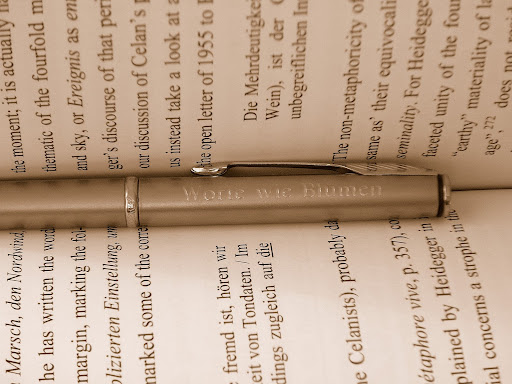
Truer to poetry than any modern contribution to the theory of metaphor is, as I would venture to say, Martin Heidegger's well-known but most often poorly understood "adage" in "Das Wesen der Sprache": As long as we take Hölderlin's Worte, wie Blumen as a metaphor, as metaphors, or even as a metaphor for metaphor, "we stay bogged down in metaphysics". This is how the English translation, by Peter D. Hertz, nicely puts it. The original text reads as follows (Unterwegs zur Sprache, p. 207):
Wir blieben in der Metaphysik hängen, wollten wir dieses Nennen Hölderlins in der Wendung »Worte wie Blumen« für eine Metapher halten.
Outrageous, like poetry.
______
* Critical Inquiry, Vol. 5, No. 1, Special Issue on Metaphor, Autumn, 1978, pp. 3-12.

Being's not a predicate, they say

Time, the unity of contradictory predicates: To be or not to be.

Wolf's-hour fragments on black bile (melancholia)

Woke up at three. Could not sleep, read some Hegel.

The black bile of melancholy knows itself: black soil.

The black bile of melancholy knows itself for what it is: black soil. Therefore it is not simply a metaphor any longer.

Black soil: I’m not sure whether this is the right word.

Mustaa multaa.

Black dirt, earth, mould... I’m still not sure, after looking it up in a dictionary.

The elements are raging in the darkness, outside. What else is my anxiety than – hmh – this picture of Climate Change seen in the window?

In introducing a word I introduce it to itself.

In introducing a word I introduce it – to itself.

Saturday, 22 December 2007

Just saw Szabó’s film on Furtwängler

My reluctance to accept the thought that a poet could “give a voice to that which has none”, or in other words, to act as a stand-in of sorts in prayer (see my “Schreiben als Form des Gebets”) – or let’s say, even, my very disgust at the thought.

What was I thinking?

Perhaps I wasn’t – but such unthought things return nachträglich. My disgust – it was directed at the idea that the most intimate, most private voicelessness, wordlessness, could be substituted, surrogated (is there such a verb? have to check), like a poem by its interpretation, as Th. S. explicated my implications... (but that’s different!)

The most intimate, private voicelessness (Schweigen) substituted by a public hearing.

Yes, music is a way of not speaking.

If I may say so.

[Added much later, a clip on Furtwängler conducting An die Freude on April 19, 1942 – "Duldet mutig, Millionen! /Duldet für die beßre Welt!" etc. – :]

Monday, 17 December 2007

Opening words

After reading just a couple of pages in Blanchot’s L’écriture du désastre, fragments on inattentiveness and one on forgiveness. [On page 89: "Pardonne-moi de te pardonner."] These offer me an escape of sorts. From what, if not from myself.

Commentary on myself, i.e. on my “thesis”:

Claiming that when Kant speaks of hypotyposes (yes, in plural: schematic and symbolical type of hypotyposis) he is not speaking of metaphor, I don’t think I was clear enough.

“Images in poetry”, this is approximately what Celan says, “are nothing visual.” Keineswegs Visuelles. Nothing visual, nothing visible. [Later, I add the exact phrase: "Bildhaftes, das ist keineswegs etwas Visuelles". I cite this on p. 206 of my Counter-figures.]

The dog is nothing visible. The schema of “dog” is even less visible, if possible, than the schema of triangle.

“The visible”, writes Merleau-Ponty, “is pregnant with the invisible”. This is precisely a comment on Heidegger’s argument against the concept of metaphor in Der Satz vom Grund.

This love of the “abstract” — it is a love for that which shall disappear. Mortality, terrestriality, temporality, and never the supra-lunar... Never? Perhaps never. Always perhaps, never for ever, never, perhaps.

Love for the ephemeral.

For words too, like flowers.

Watch their éclosion in the morning light.